
Protecting badgers in the University Parks
Managing the University Parks means balancing public access, historic structures and protected wildlife within a living, layered landscape. When a newly established badger sett developed beneath a footpath close to the Cricket Pavilion, our approach was guided by a clear principle: retain and protect what is already here, both above and below ground, while keeping people moving safely through the park.
Working closely with specialist ecologists at EcoConsult, a detailed Badger Method Statement was developed and agreed with Natural England. Rather than closing the sett entirely, the preferred solution was to retain it in situ, redesign the path network around it and install discreet below ground protection to prevent further undermining of the Pavilion compound and adjacent sports areas.
Before any groundworks took place, affected sett entrances were fitted with outward opening one way badger gates and monitored at regular three day intervals over a 21 day period. This allowed badgers to leave naturally while preventing re entry into areas where works were required. Monitoring confirmed no activity at the affected entrances, while the wider sett remained active outside the works area.
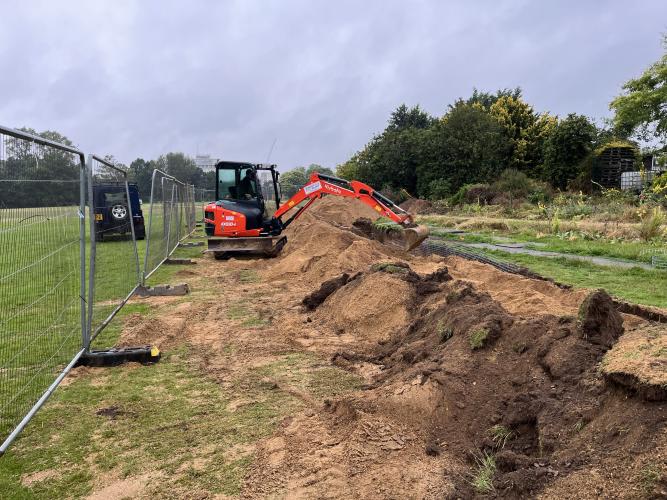
Only once the site was confirmed clear did excavation proceed, carried out carefully using small plant and hand tools under ecological supervision. All tunnel ends were visible and checked, and no badgers were encountered at any stage. Crucially, the main sett was retained, with underground badger proof fencing installed to control future tunnelling while allowing continued access and movement beneath the park.
Alongside these ecological constraints, archaeology was also a key consideration throughout the project. The University Parks sit above a rich archaeological landscape, and all groundworks were monitored accordingly. During excavation, archaeological material was identified, including Iron Age and medieval pottery. These finds highlighted the long and continuous history of activity beneath the Parks and reinforced the need for a cautious, observational approach to digging.
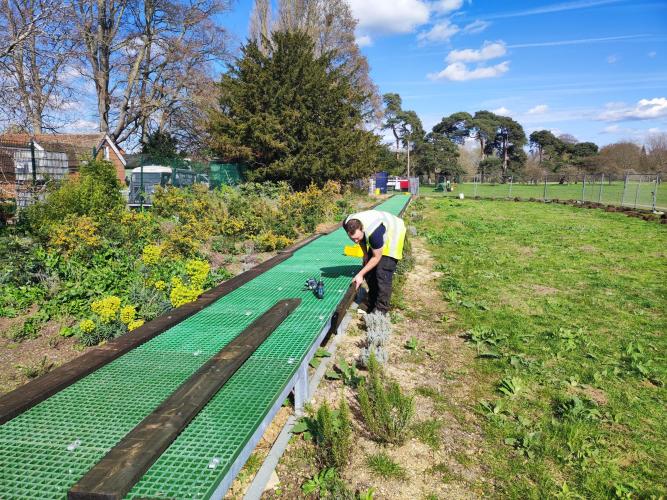
To reopen the original pedestrian route without disturbing either the retained sett or the archaeology below, we worked with specialist local metal fabricators to design and install a bespoke raised walkway. The galvanised steel structure was engineered to spread loads evenly, avoid excavation or driven foundations, and exert ground pressure little more than that of a pedestrian. Raised by a minimum of 260mm, the walkway allows badgers to continue commuting freely beneath it, with key sections designed to span existing and potential sett entrances.
The final stage of the project focused on re landscaping and long term protection of the site. The Pavilion border was replanted using species selected to thrive in full sun with minimal water requirements, ensuring resilience while reducing ongoing maintenance. Alongside the new raised walkway, areas were seeded with wildflower mixes. Not only will this enhance the visual quality of the route and support pollinators, it also serves a practical purpose by discouraging people from walking directly over the badger sett and helping to protect the ground beneath.
Installation and planting were carried out using non invasive techniques, restoring public access along the original route while leaving the badger sett intact, the archaeology undisturbed, and the landscape strengthened for the future.
From start to finish, this project was about slowing down, listening to expert advice and designing solutions that respected ecology, archaeology, heritage and access equally. It is a piece of work the Parks team are particularly proud of, and a strong example of how thoughtful project management and collaboration can deliver practical outcomes without compromising what makes the University Parks special.